
Overview
I conceived and art-directed Field Guide, an explorer app that works like a scout's field guide from the 1950s. It covers 283 places in eight regions: Fruška Gora, Novi Sad and the lost places of the Zone in Serbia; Zagreb, Opatija and Pula in Croatia; Amsterdam; and San Francisco. Every place has its own illustration in a mid-century print style and its own collectible badge. You visit a place, mark it as visited, and watch the region fill up. It runs in the browser, installs to a phone's home screen like an app, and reads in ten languages.
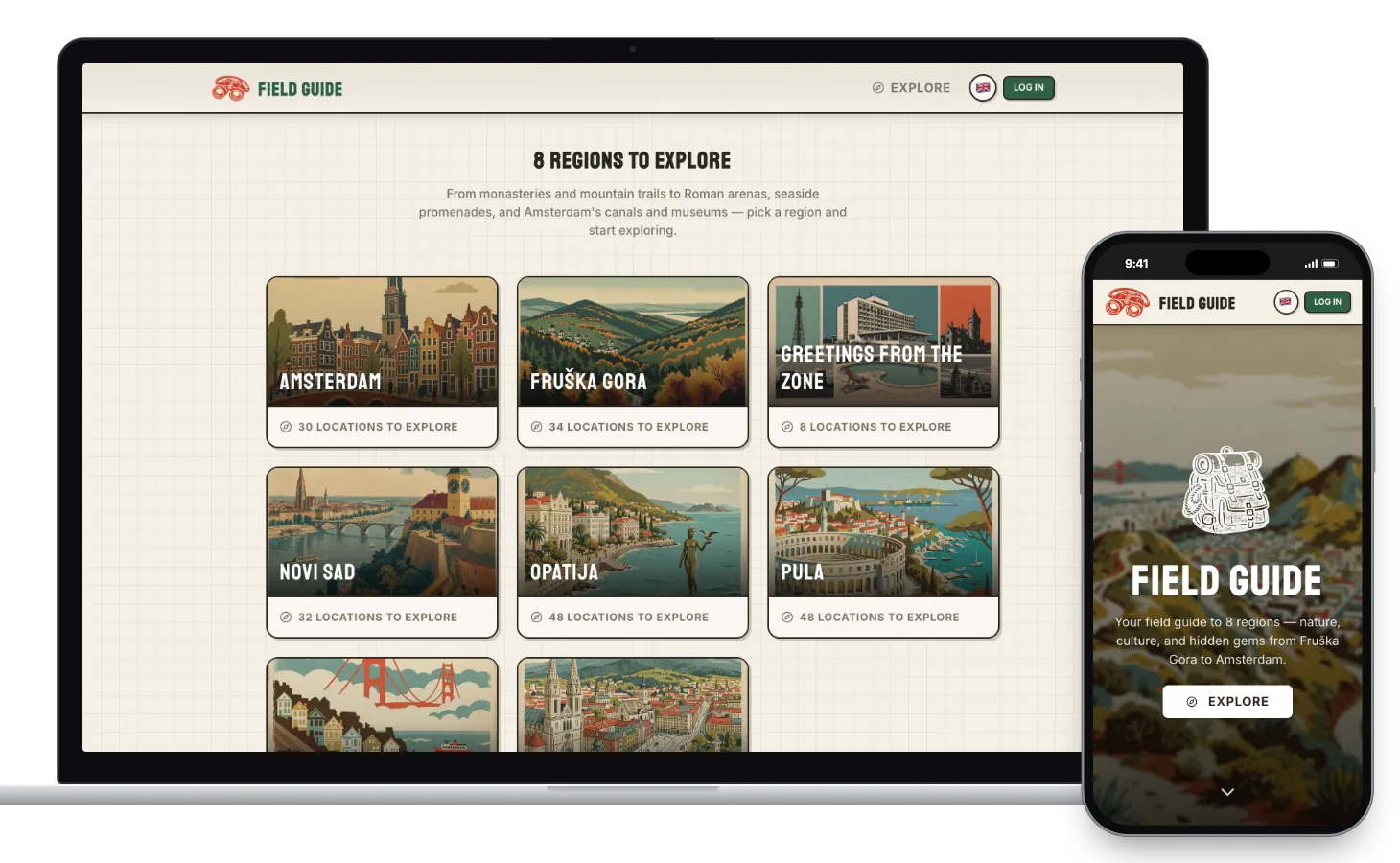
The landing page on a laptop and a phone: eight regions, each drawn as a travel poster.
Explore a region like a scout
My brief, in March 2026, asked for a game of regional discovery. You browse the regions, open one and see the list of places to complete. You mark each place as visited, earn its badge, and finally complete the whole region.
The brief also set the feeling: scouts, a 1950s field guide, collectible round patches, mid-century illustration and the energy of an old travel poster. It had to stay clean, readable and built for the phone first.
It started with one region, Fruška Gora, Serbia's oldest national park, with its monasteries, wartime memorials, hidden lakes and viewpoints. Seven more regions followed over the next five months.
What it does
Regions and places
Every region opens with its illustration, its master badge, a short description and a progress bar. Below them sits the list of places, with search, category filters and three tabs: all places, the ones you have visited and the ones on your wishlist.
Each place has a page with its illustration, its badge, its category and a short description, and one large button at the bottom: Mark as Visited. In Fruška Gora, 33 of the 34 places also have four seasonal illustrations, and the app shows the one for the season you are in.
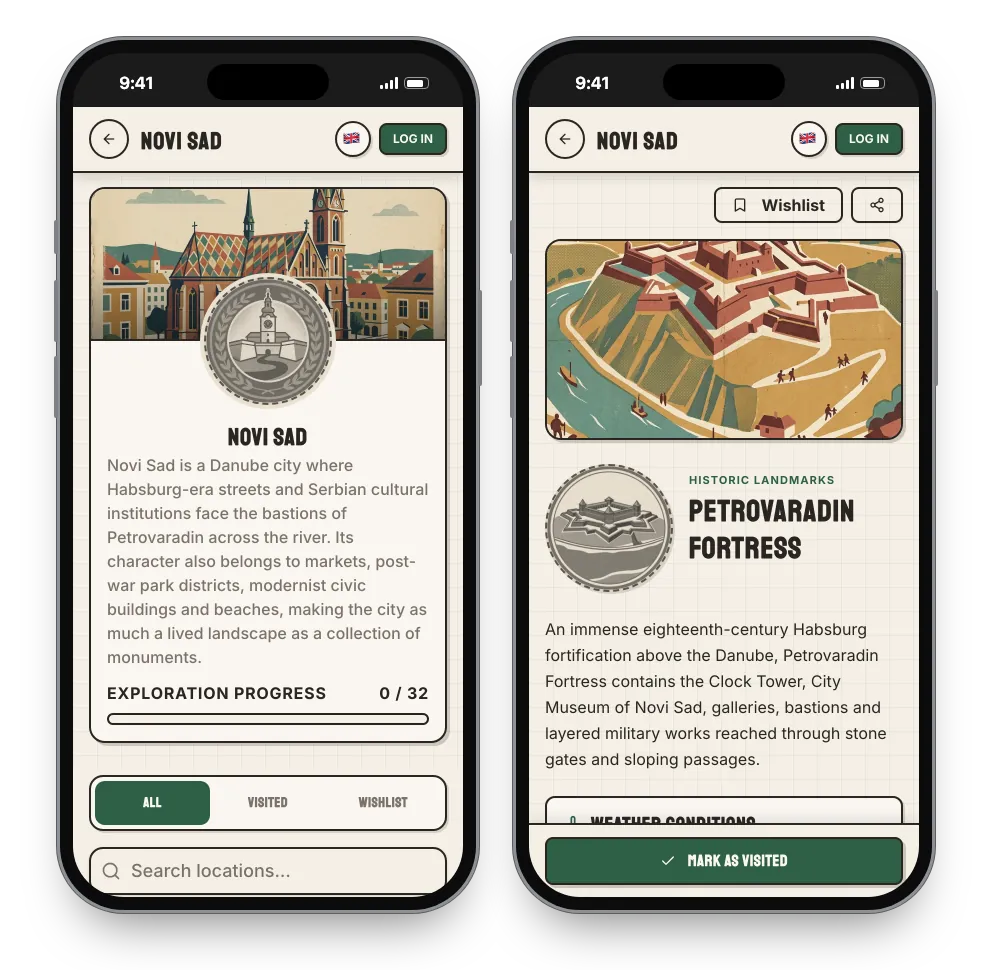
Novi Sad and one of its 32 places, Petrovaradin Fortress, each with its own badge.
Ready for the trail
A place page also tells you what to expect when you get there. It shows the weather on site right now: temperature, wind, sunrise and sunset, what to wear, how the ground is after the last three days of rain, and whether wood will light for a fire. A map shows where the place is, and Open in Maps hands the place to Google Maps or Apple Maps. Next Steps suggests the two nearest places, with the distance and the walking time to each.
The Fruška Gora list, and Krušedol Monastery down to its weather, map and nearest places.
Badges and awards
Every place has a badge drawn as a round scout patch, and every region has a master badge. Marking a place as visited earns its badge. Awards come on top for milestones: a first visit, half a region, a whole region, or every place in one of the ten categories, such as monasteries and churches or abandoned places.
Anyone can browse every region and every place without an account. Signing in with Google saves your visits, badges and wishlist.
Greetings from the Zone
One region works differently from the rest. Greetings from the Zone gathers eight lost places of Fruška Gora: derelict resorts, an abandoned village, a bombed broadcast tower, a Roman fort, an abandoned quarry and a roofless mansion. Each one is pictured at its peak, the way it looked on the postcards of its day.
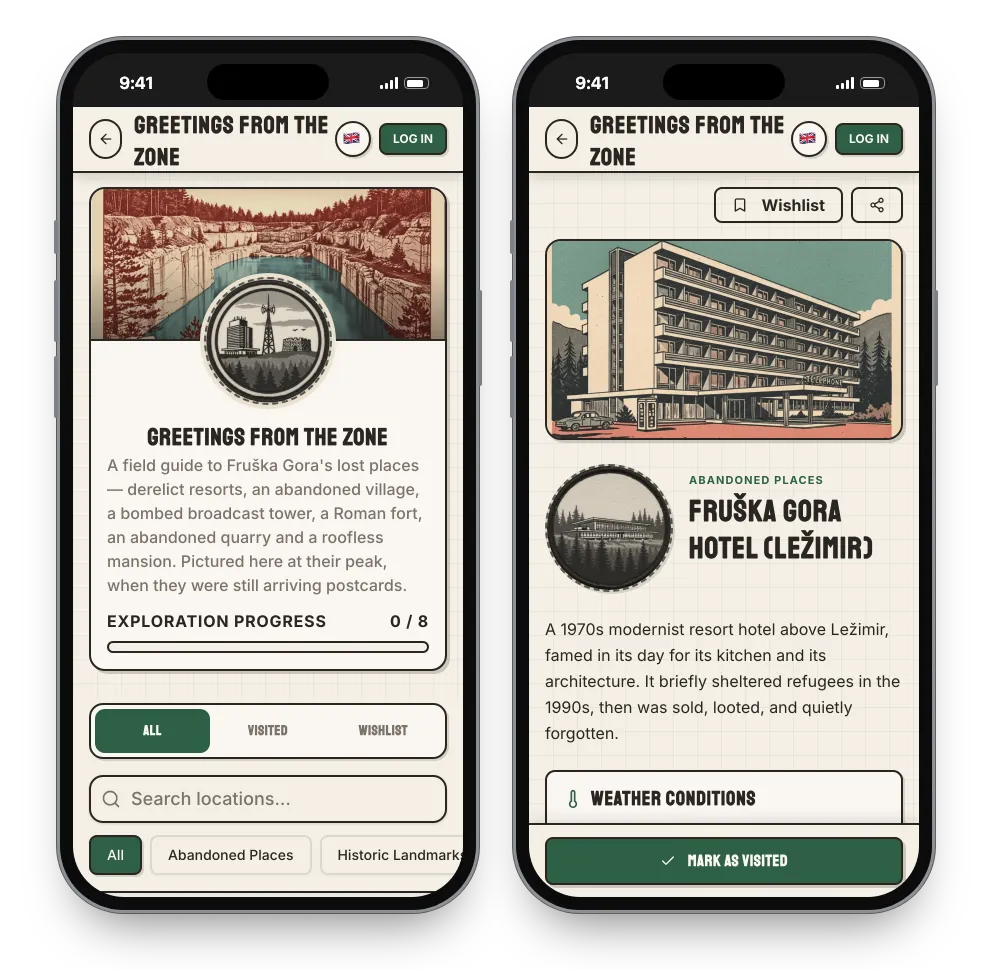
Greetings from the Zone: the lost places of Fruška Gora, drawn as they were in their prime.
Ten languages
The interface reads in ten languages: English, Serbian, Hungarian, German, Romanian, Russian, Ukrainian, Bulgarian, Slovenian and Chinese. The places of Fruška Gora and the Zone are translated into all ten as well. The language is part of the address, so a shared link opens in the language it was sent in.
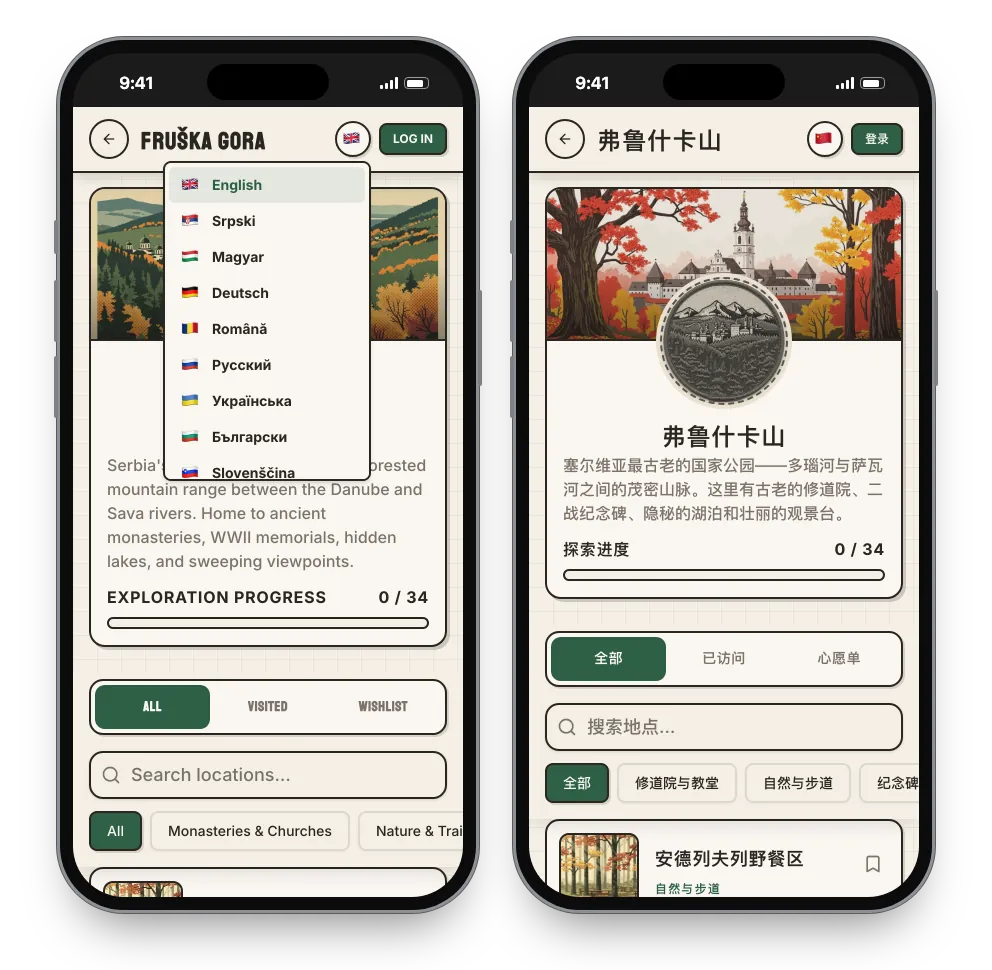
The language menu, and Fruška Gora in Chinese.
Made to be shared
Any place can go on your wishlist for later. A shared link opens without an account, and in messaging apps such as Viber it arrives with the place's illustration as its preview card. The app can also draw a tall story picture of a place for sharing, and it has its own Instagram account, field.guide.neusatz.
My role
Field Guide is my own project. I came up with the idea, set it out in a product brief and set the art direction in a style guide of its own: flat colour blocks, clear silhouettes, halftone grain, slight misregistration and three to six muted colours, with graphic clarity ahead of accuracy. I chose the regions and gave each one a brief: its places, their categories and what makes each worth a visit.
The app was built with Replit Agent, Replit's AI coding agent, working from those briefs. It also generated the illustrations and badges to the style guide. When a set drifted from the style, as the first Amsterdam illustrations did, it was redrawn with stricter wording. When I visit a place, I can send my own photo of it, and it comes back as an illustration in the house style that replaces the old one.
How it was built
Field Guide is a progressive web app: a React front end that installs to the home screen and keeps working offline once it has loaded, with a small server behind it for accounts, visits and badges. The maps come from OpenStreetMap and the weather from Open-Meteo.
From Replit to my own Cloudflare account
It started on Replit, as an Express server with a PostgreSQL database. On 19 October 2026 I moved it to my own Cloudflare account with Claude Code, Anthropic's AI coding tool. It now runs as one Cloudflare Worker with a SQLite database, behind a Cloudflare Pages front door that holds the field.guide.neusatz.cc address.
The move kept the data intact. The production database was copied across with its original ids. In a rehearsal before the switch, 628 of 636 public answers from the new server matched the old one exactly; the other eight differed only in the order of a list the app does not display. After the switch, the full live check passed 68 of 68. Every deploy now runs the tests, publishes, and then checks the live site before it counts as done.
Numbers
- Eight regions in four countries: Serbia, Croatia, the Netherlands and the United States
- 283 places, each with its own illustration and badge
- Ten categories, each with an award for visiting every place in it
- Ten languages, with Fruška Gora and the Zone translated in full
- Eight regions added in five months, from Fruška Gora in March 2026 to Amsterdam and San Francisco in August 2026
- 14 registered users when it moved to Cloudflare in October 2026